
Odd News
Science · Published November 10, 2026
Where the Name 'Uncanny Valley' Came From
 AI doodle
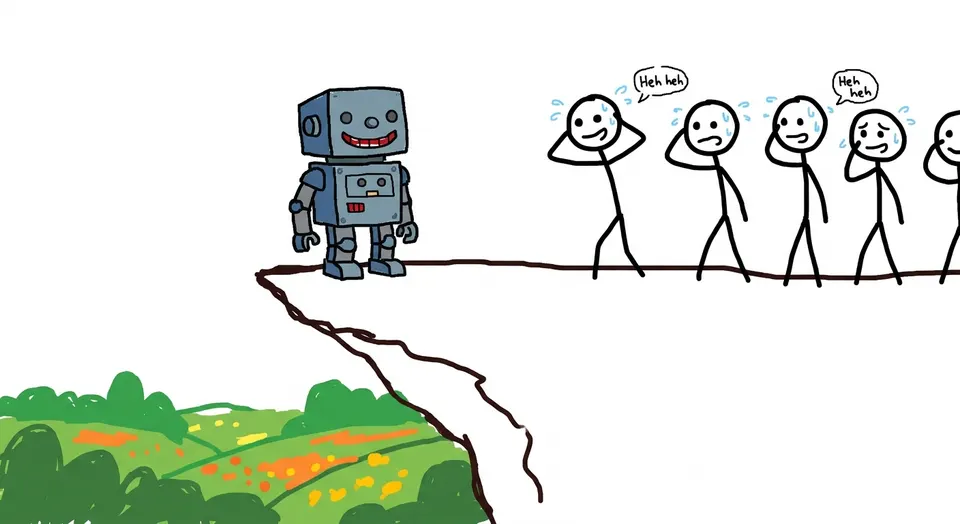
Lately, eerie makeup looks have been blowing up on TikTok, and that's made "uncanny valley" a common phrase. But it doesn't just mean "creepy." It has a fairly specific meaning and origin. It refers to the discomfort you feel when something is made to look human but falls just short, leaving you unsure whether it's human or not. Humanoid robots, AI faces, dolls, and wax figures can all fall into this category.
The idea came from Masahiro Mori, a professor at the Tokyo Institute of Technology. He spent more than 40 years researching robots, and in the 1970s he even developed a humanoid robot that could walk on two legs. Along the way, he noticed that people's feelings toward human-like robots don't always rise in a straight line. Simple industrial robots in factories barely get a reaction, but a robot with a face can feel friendly. However, once a robot gets close to being indistinguishable from a person, that friendliness suddenly flips into aversion. Mori plotted this shift on a graph, and the line dipped sharply downward, looking like a valley. So he named that valley the "uncanny valley."
Mori himself admitted that the theory came more from intuition than from scientific experiments. He didn't see it as a problem to be overcome, but as a phenomenon that robot designers should be aware of. In effect, he advised that since human-like robots can make people uncomfortable, it may be better to make them deliberately less human. In 2019, researchers at Aachen University in Germany confirmed that this effect actually occurs in the brain. The intensity of the reaction also varied from person to person. So there may never be a robot design that satisfies everyone.
The higher the number, the more useless the story
Uselessly fun?
Key facts
- The concept was proposed by Japanese roboticist Masahiro Mori.
- It describes the unease people feel toward beings that are nearly human but not quite.
- In 2019, German researchers reported that several regions of the brain are involved in this reaction.
Q. When was the last time something in your everyday life felt 'almost right but slightly off' and made you uneasy?
Read the originalMental Floss ↗AI read the Mental Floss article and rewrote it in its own words (in Korean, then machine-translated). It is not a translation of the original. It passes our review rules before going up, but please check the original for exact details and photos. Correction or removal requests from rights holders are handled within 24 hours.