

Odd News
History · On Wikipedia October 27, 2024
The Chinese Song Dynasty Iron Bell That Ended Up in a Ganghwa Temple
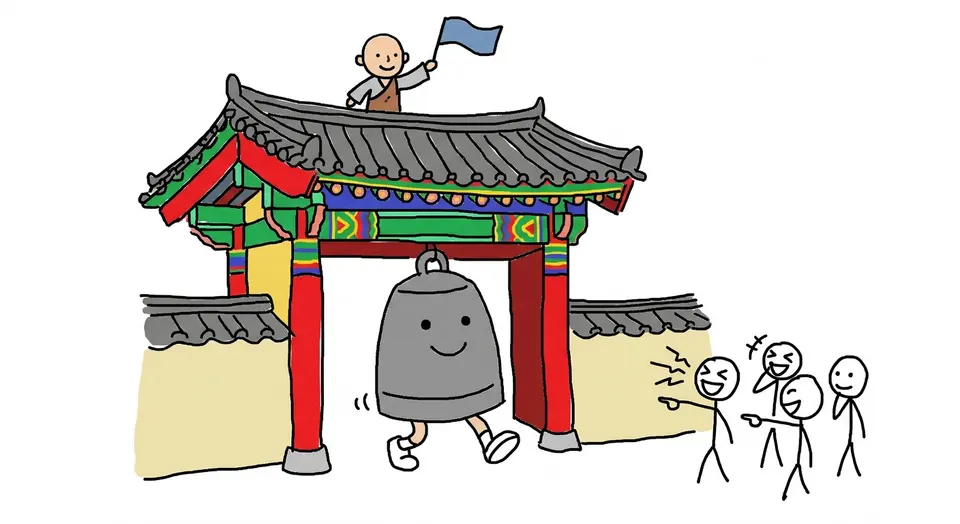 AI doodle
The bell was cast from iron in 1097, during China's Northern Song period, at Sungmyeong Temple on Baeamsan Mountain in Henan Province. It stands about 1.64 meters tall and has a mouth diameter of 1 meter. Its handle is shaped like two dragons with their backs pressed together.
How the bell got to the Korean Peninsula is more a matter of chance. During World War II, the Japanese army gathered scrap metal from its colonies to get materials for weapons. This bell was moved to the Bupyeong Arsenal. After liberation, the bell found at the Bupyeong Arsenal was taken to Jeondeungsa Temple on Ganghwa Island, where it has been preserved ever since.
The bell's body is engraved with eight-trigram patterns and eight square panels arranged in two rows. Inscriptions inside them record the year and place of casting. Thanks to these inscriptions, the bell is also an important reference in the study of Chinese bells.
The higher the number, the more useless the story
Uselessly fun?
Key facts
- It is an iron bell cast in 1097 at Sungmyeong Temple in Henan Province, China.
- During World War II, the Japanese army moved it to the Bupyeong Arsenal, and after liberation it was taken to Jeondeungsa Temple on Ganghwa Island.
- It was designated Treasure No. 393 in 1963.
Q. Are there other cases of old objects that were taken as war materials and somehow survived?
Read the originalKorean Wikipedia ↗This story was rewritten from a Korean Wikipedia article, so it's used under CC BY-SA 4.0 (attribution, share alike).
AI read the Korean Wikipedia article and rewrote it in its own words (in Korean, then machine-translated). It is not a translation of the original. It passes our review rules before going up, but please check the original for exact details and photos. Correction or removal requests from rights holders are handled within 24 hours.